
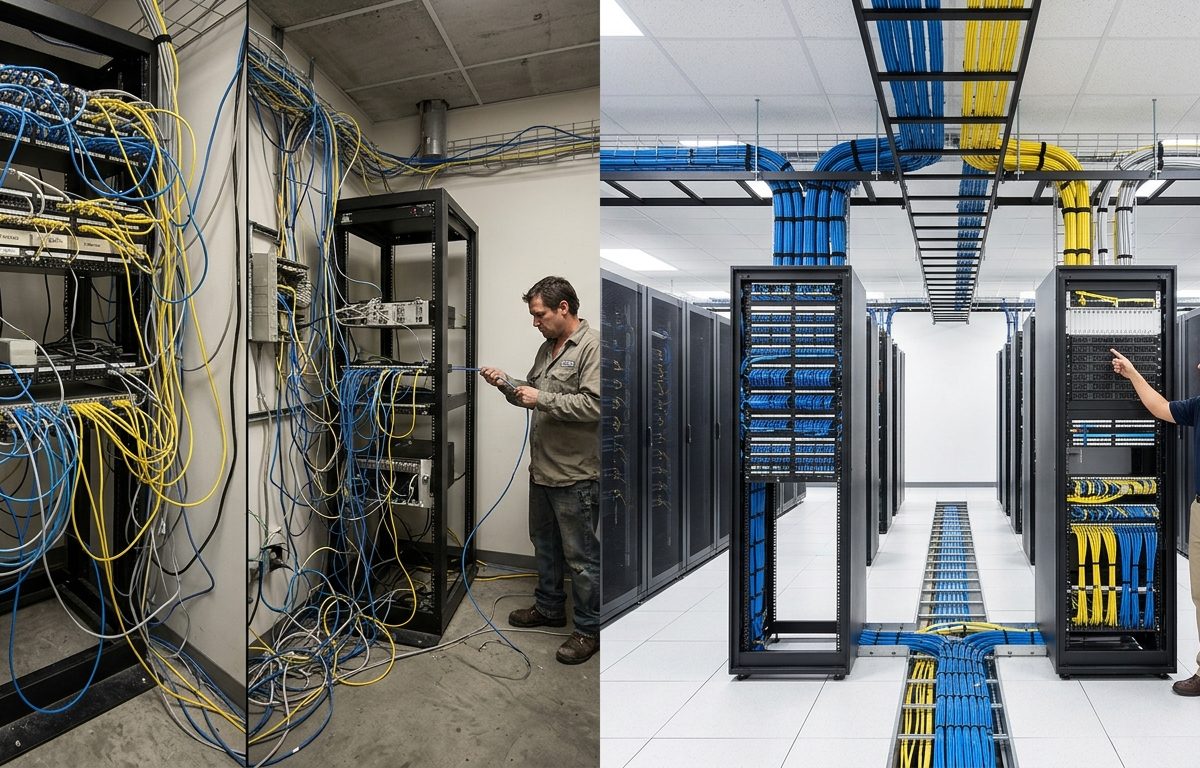
Structured Cabling vs. Conventional Wiring: Differences & Which Is Better?
Reliable connectivity is essential for modern businesses. From computers and servers to wireless access points and security cameras, every connected device depends on an effective network infrastructure.
Understanding Structured Cabling vs. Conventional Wiring helps businesses choose a solution that meets their current needs while allowing room for future growth. Although both approaches provide physical network connections, they differ in organization, scalability, maintenance, and long-term costs.
This guide explains how each system works, compares its advantages and disadvantages, and explores how Arab Computers can help businesses evaluate their networking requirements.
What Is Conventional Wiring?
Conventional wiring is a traditional method of connecting network devices using individual cables. In a point-to-point arrangement, a cable connects a network switch or another networking component directly to an endpoint, such as a computer, printer, or IP camera.
This approach can be practical for small offices with limited equipment and relatively stable network requirements. It may also require fewer initial components because a simple installation does not necessarily need extensive patch panels or distribution infrastructure.
However, conventional wiring can become difficult to manage as the number of connected devices increases.
Common challenges include:
– Cable congestion: Multiple connections can create tangled cables around equipment racks and workspaces.
– Difficult troubleshooting: Identifying a faulty connection can take longer when cables are poorly labeled.
– Limited flexibility: Moving devices or expanding the network may require additional cable runs.
– Maintenance challenges: Disorganized connections can make upgrades and repairs more complicated.
Conventional wiring is not inherently unreliable. Its effectiveness depends on installation quality, cable management, and the complexity of the network.
What Is Structured Cabling?
Structured cabling is a standardized approach to organizing a building’s telecommunications infrastructure. It uses planned cable routes, centralized termination points, patch panels, and network outlets to create a consistent system.
Instead of connecting every device through an improvised arrangement, structured cabling typically follows a star topology. Permanent cables connect work-area outlets to patch panels, which technicians connect to network switches using shorter patch cords.
Main Components of Structured Cabling
A structured cabling system commonly includes:
– Horizontal cabling: Connects work-area outlets to patch panels in telecommunications rooms.
– Backbone cabling: Connects equipment rooms and telecommunications rooms, often using fiber optics where appropriate.
– Patch panels: Organize cable terminations and simplify connection changes.
– Network outlets: Provide standardized connections for computers, IP phones, and other devices.
– Racks and cable management: Keep equipment accessible and cables organized.
Standards such as ANSI/TIA-568 and ISO/IEC 11801 provide guidance for cabling design and performance.
Structured cabling supports business applications including voice communications, data networks, wireless access points, IP surveillance, and compatible building systems. Its main advantage is a consistent infrastructure that can be maintained and expanded more systematically.
Key Differences Between Structured Cabling and Conventional Wiring
The primary distinction between Structured Cabling vs. Conventional Wiring is the way connections are designed, organized, and managed.
- Organization and Cable Management
Conventional wiring can become cluttered when numerous cables connect directly to networking equipment.
Structured cabling uses patch panels, labeling, and organized pathways to make individual connections easier to identify. This approach can improve accessibility and reduce cable congestion.
Best option: Structured cabling for offices and facilities with numerous connected devices.
- Scalability and Flexibility
Conventional wiring may require additional cable installation when a business expands or relocates equipment.
Structured cabling makes many network changes simpler because technicians can modify patch connections without replacing permanent cable runs. New devices may still require additional cabling if suitable connections are unavailable.
Best option: Structured cabling for growing businesses.
- Troubleshooting and Maintenance
Poorly organized wiring can increase the time needed to trace faulty connections.
A properly labeled structured cabling system provides clearer connection paths and documented termination points, helping technicians identify potential problems more efficiently.
Best option: Structured cabling for organizations that prioritize manageable network infrastructure.
- Installation Costs
Conventional wiring may cost less initially for small, simple installations. Structured cabling generally requires more planning and may involve patch panels, racks, cable pathways, and testing.
However, businesses should also consider maintenance labor, future modifications, and potential downtime when comparing total costs.
- Network Performance
Neither approach automatically delivers faster network speeds. Performance depends on cable category, installation quality, distance, network equipment, and application requirements.
Cat6 and Cat6A copper cables support different Ethernet applications, while fiber optic cabling can provide high-bandwidth connections over longer distances.
Structured cabling helps businesses select and organize the appropriate infrastructure for their technical requirements.
Pros and Cons Comparison
Understanding the advantages and limitations of both approaches helps businesses select an infrastructure that matches their operational needs.
- Structured Cabling
Advantages:
– Organized and clearly labeled connections.
– Easier network administration and troubleshooting.
– Greater flexibility for future expansion.
– Support for integrated voice, data, and security systems.
– Better separation between permanent cabling and active equipment.
- Disadvantages:
– Potentially higher upfront installation costs.
– Requires careful planning and professional installation.
– Needs appropriate testing and documentation.
- Conventional Wiring
Advantages:
– Simple to implement in small environments.
– Potentially lower initial costs.
– Suitable for limited or temporary connections.
- Disadvantages:
– Cable congestion can increase as networks grow.
– Troubleshooting may become more difficult.
– Frequent changes can require additional installation work.
The best choice depends on the facility’s size, network complexity, budget, and expected growth.
Which Is Better for Your Business?
For most permanent commercial networks, structured cabling offers greater flexibility and easier long-term management. However, the appropriate solution depends on your operational requirements.
Small offices: Conventional wiring may be sufficient for a few devices. Structured cabling becomes more attractive when expansion is expected.
Corporate offices: Structured cabling helps organize connections across workstations, meeting rooms, printers, and wireless access points.
Server rooms and data centers: Structured cabling supports organized equipment connections, easier maintenance, and more manageable cable pathways.
Healthcare, education, and retail: These environments may benefit from a planned infrastructure connecting workstations, surveillance cameras, wireless networks, and other compatible devices.
Before choosing between Structured Cabling vs. Conventional Wiring, consider the number of devices, required bandwidth, cable distances, future expansion, and maintenance expectations.
How Arab Computers Can Help?
Choosing a cabling architecture is only one part of building reliable IT infrastructure. Businesses should also evaluate the experience, technical knowledge, communication, and support capabilities of their prospective service provider.
Arab Computers can be approached to discuss enterprise networking requirements and explore suitable infrastructure solutions.
When evaluating a provider, consider the following factors:
– Technical expertise: Look for an understanding of copper and fiber optic cabling, network design, and installation requirements.
– Customized planning: The proposed solution should reflect your building layout, device requirements, and expected growth.
– Installation and testing: Ask about cable termination, performance testing, labeling, and project documentation.
– Technology compatibility: Ensure the infrastructure can support your networking equipment and intended applications.
– Communication and support: Confirm project responsibilities, delivery expectations, and arrangements for future maintenance.
A well-planned structured cabling installation should match the organization’s actual needs rather than rely on unnecessary components or unsupported performance promises.
Contact Arab Computers to discuss your business connectivity requirements and determine which network infrastructure approach may be appropriate for your facility.
