
NAS vs SAN: Which Storage Solution is Right for Your Business?
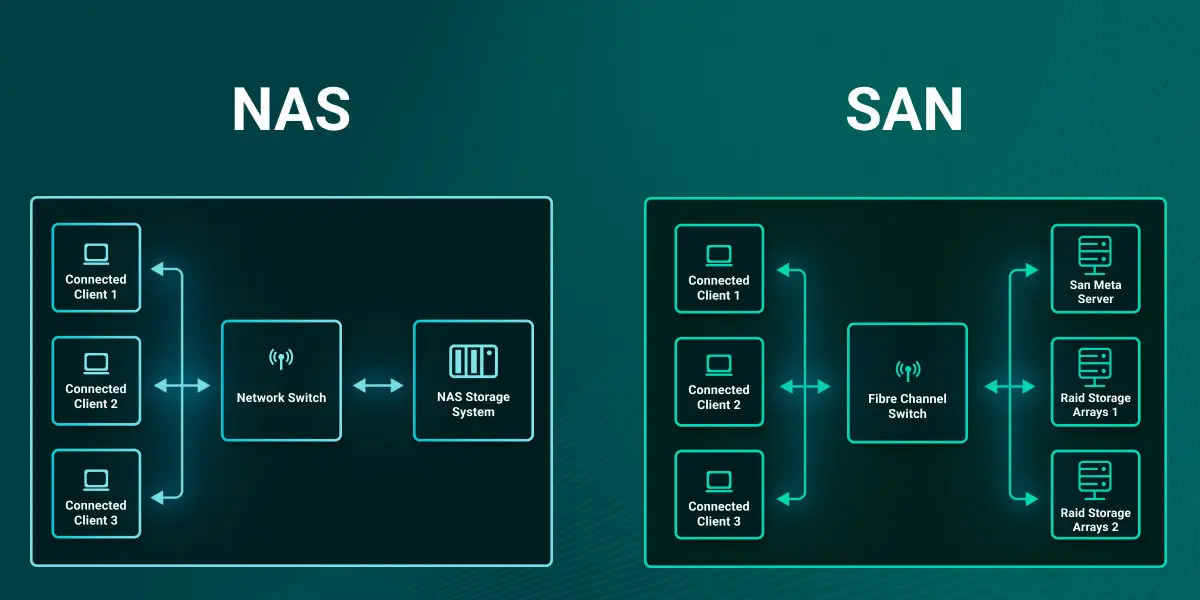
In today’s data-driven landscape, choosing the right storage architecture is not just a technical decision—it’s a strategic one. As your business grows, so does your need for secure, scalable, and high-performing data access. The debate often boils down to two heavyweights: the NAS vs SAN: Which Storage ,NAS (Network Attached Storage) and SAN (Storage Area Network).
At Arab Computers, your trusted partner for enterprise IT solutions in Egypt, we help you navigate these complexities. This guide will break down the differences to help you choose the best fit for your infrastructure.
What is NAS (Network Attached Storage)?
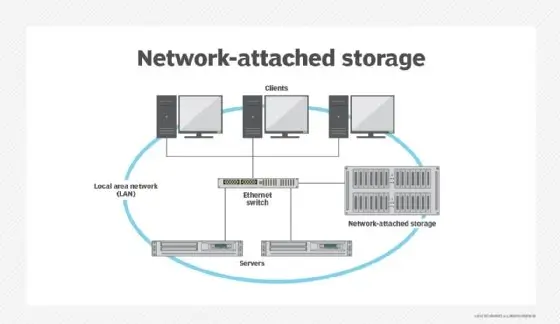
NAS is a file-level storage device connected to a standard Ethernet network. Think of it as a specialized, high-performance “private cloud” for your office.
Key Benefits of NAS:
- Ease of Use: Simple to set up and manage without a dedicated fiber-optic network.
- Cost-Effective: Lower entry cost, making it ideal for Small to Medium Businesses (SMBs).
- File Sharing: Excellent for centralized document storage, media sharing, and collaborative workflows.
- Scalability: Most NAS units (like those from Lenovo or HP) allow you to add drives as your data grows.
What is SAN (Storage Area Network)?
SAN is a specialized, high-speed network that provides block-level network access to storage. It connects servers to data storage devices (such as disk arrays) via Fibre Channel or iSCSI.
Key Benefits of SAN:
- Unmatched Performance: Since it handles data in blocks, it is significantly faster than NAS for heavy workloads.
- No Network Bottlenecks: It operates on its own dedicated network, so it doesn’t slow down your local LAN.
- Mission-Critical Reliability: Designed for high availability and disaster recovery.
- Best for Virtualization: Ideal for running multiple Virtual Machines (VMs) and large-scale databases.
Comparison: NAS vs. SAN at a Glance
| Feature | NAS (Network Attached Storage) | SAN (Storage Area Network) |
| Data Processing | File-level (Files & Folders) | Block-level (Volume-based) |
| Connectivity | Standard Ethernet (TCP/IP) | Fibre Channel or iSCSI |
| Complexity | Low – Easy to manage | High – Requires IT expertise |
| Primary Goal | Sharing files & Backup | High-speed app performance |
| Ideal For | SMBs, Creative Agencies | Enterprises, Data Centers |
The Verdict: Which One Should You Choose?
Choose NAS if:
- You need a simple way to share files among employees.
- You are looking for a cost-effective backup solution.
- You don’t have a dedicated team of storage engineers.
Choose SAN if:
- You are running heavy database applications (like SQL or Oracle).
- You are managing a large-scale virtualization environment (VMware/Hyper-V).
- Your business cannot afford even a few seconds of latency or downtime.
Frequently Asked Questions
1. Can a business use both NAS and SAN?
Yes. Many large organizations use a Unified Storage approach, where they utilize SAN for their high-performance databases and NAS for their general file sharing and archiving.
2. Which is more secure: NAS or SAN?
Both can be highly secure. However, because SAN is often isolated on its own dedicated network, it is inherently less exposed to standard network-based attacks compared to a NAS connected to the general LAN.
3. Which brands offer the best NAS and SAN solutions in Egypt?
As an authorized dealer, Arab Computers recommends Dell EMC, HPE, and Lenovo. These brands provide the most reliable hardware with local support and warranty services.
Ready to Upgrade Your Storage?
Choosing between NAS and SAN depends on your specific workload and budget. At Arab Computers, we provide end-to-end IT infrastructure consultancy, from hardware procurement to professional installation.
